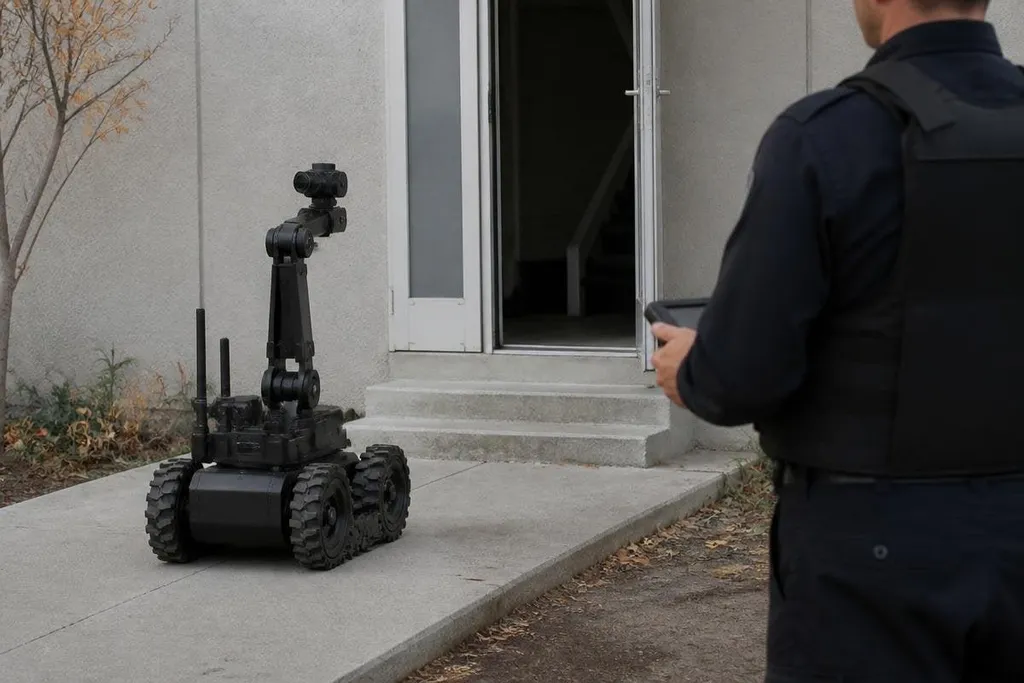
A police robot can enter a room, send live video, or speak to someone while an officer stays outside. Those uses may reduce danger, but they also raise hard questions about privacy, force, and who answers when the system fails.
- Remote control keeps an officer responsible for each action.
- Cameras and microphones can collect more data than a single incident requires.
- Autonomous movement needs clear limits before it reaches public spaces.
What the robot is allowed to do
The first question is simple: what job is the robot doing? A machine used to inspect a suspicious package raises different concerns from one that watches a protest or searches a home.
A remote-controlled robot can carry a camera, microphone, speaker, or tool. Each part changes the rules.
Video may show a threat, while audio may record private conversations from nearby rooms. A tool that opens a door may also damage property or change a scene that later matters in court.
Police agencies should state the permitted task before buying the machine. “Keep officers away from danger” describes a goal, not a limit. A policy needs to say where the robot may go, what sensors it may use, how long it may record, and who can approve a new use.
The person behind the controls
Remote control does not remove human responsibility. An officer chooses where the robot moves, what it records, and what action it takes after receiving the video feed.
That link can weaken when several people share control, when the video arrives late, or when an operator cannot see the full scene. A clear log should connect each command to a named operator and a time. The record should also show when a supervisor approved a higher-risk action.
This matters after an injury, property loss, or disputed arrest. A department needs more than a claim that “the robot did it.” The machine followed commands, and a person or agency must explain those commands.
Police robot trials need a dated account of the department, robot, task, and human decision-maker. Police robotics reporting from Robot24.com can tie those facts to the incident data the machine stores, leading to the next question: who keeps that data, and for how long?
Data can outlast the incident
A robot may collect video, sound, location data, and images of people who have no link to a case. Storage turns a short operation into a record that can be copied, searched, or sent to another agency.
Face recognition adds a separate risk. A camera can record a face without naming anyone. A recognition system tries to match that face to a database, and a wrong match can send officers toward the wrong person.
Rules should cover the full data path. The public needs to know when recording starts, who can view the files, how long the files stay available, and when they are deleted. Access should leave a log that an outside reviewer can check.
Privacy also depends on place. A robot in a sealed industrial building is different from a robot on a public street. The same camera may be reasonable during a search for an armed suspect and excessive during routine crowd monitoring.
Force and the problem of distance
Police robots can place physical distance between an officer and a person. That may lower danger for officers, bystanders, and the person being detained. Distance can also make force feel easier to order because the operator is away from the scene.
A department should set a high threshold for any robot that can deliver force. The policy should name the allowed tool, the reason for its use, the approval level, and the review that follows. A live emergency may limit the time for approval, but it cannot erase the need for a record.
I’d oppose police robots carrying force tools unless the agency can publish those limits and show how it checks each use. A technical demo proves that a robot can perform an action. It does not prove that the action belongs in policing.
A buying checklist for police agencies
Before approving a purchase, ask:
- Defined task: Can the agency name the exact job and place of use?
- Human control: Does a named officer approve each high-risk action?
- Data limits: Are recording, access, retention, and deletion rules written down?
- Public notice: Can residents read the policy before routine use begins?
- Independent review: Who checks logs, complaints, injuries, and false identifications?
The strongest policy gives the public a way to challenge misuse, preserves records for review, and sets a date for the agency to revisit the rules. A police robot should earn wider use through documented results and outside scrutiny, not through a convincing demonstration.